RED BULL FROM ½ PALLET · FREE UK SHIPPING FROM 1 PALLETWhatsApp +44 7999 150302 ↗

How to Plan Wholesale Drinks Stock for a Small UK Convenience Store
Learn how much drinks stock a UK convenience store needs, calculate reorder points and case quantities, and judge whether wholesale pallets fit your sales.

There is a familiar problem in small shops: the drink that sells every day is suddenly missing from the fridge, while a few cases of last month’s exciting flavour are still taking up space in the back room. Good convenience store drinks stock planning is less about guessing which brand will be popular next and more about knowing how quickly each product sells, how long replenishment takes and how much you can afford to hold.
That matters in a market where the category is still important but retailers are under pressure. The Association of Convenience Stores’ 2026 Local Shop Report forecasts £49.1 billion in UK convenience-sector sales, while drawing attention to rising operating costs and subdued investment. For an independent retailer, cash tied up in slow-moving stock is cash that cannot be used elsewhere. The aim is simple: keep your dependable sellers available without ordering more drinks than your space, demand or remaining shelf life can justify.
Convenience store drinks stock planning starts with what actually sells
Start with four weeks of till data if you have it. Note the exact product, flavour and size, not just “energy drinks” or “cola”. Red Bull Original 250ml and Red Bull Sugarfree 250ml are separate stock-keeping units (SKUs); so are Monster Original Green 500ml and Monster Ultra White 500ml. An average across the whole brand can hide the fact that one flavour sells every day while another barely moves. Include chilled and back-room stock in your count, and make a note of days when a product was unavailable: otherwise a stockout can make genuine demand look smaller than it is.
For each SKU, divide the units sold by the number of days you were actually able to sell it. If you sold 336 cans of one product over 28 days without a stockout, that’s an average of 12 cans a day. Check Fridays, weekends and local events separately if they change the pattern. The UK’s Retail Economics and DHL 2026 availability research notes that smaller convenience formats are particularly vulnerable to gaps because of their limited ranges and storage. Losing a sale from a fast-moving line can be more costly than losing a little variety from the bottom of the range.
Know exactly when to reorder: a straightforward formula
A reorder point is the stock level at which you need to take action so that the next delivery arrives before the product runs out. A practical starting formula is average daily unit sales × supplier lead time in days + safety stock. That approach is also described in the UK government’s inventory-management guidance. Safety stock is the extra quantity you hold for a busy spell or a delivery delay; it should be based on your business’s experience, not a universal percentage copied from another shop.
Consider an illustrative shop selling 12 cans a day of one popular 250ml drink. Assume replenishment normally takes five calendar days from placing a confirmed order, and the shop wants another three days of safety stock. The reorder point is 12 × (5 + 3) = 96 cans, or four complete 24-can cases. When the stock position falls to around that level, it’s time to review replenishment. If there are already confirmed deliveries on the way, count them too rather than ordering the same stock twice.
| Worked reorder example | Calculation | Result |
|---|---|---|
| Average daily sales | 336 units ÷ 28 days | 12 cans/day |
| Expected supply lead time | Illustrative planning assumption | 5 days |
| Safety allowance | 12 × 3 days | 36 cans |
| Reorder point | (12 × 5) + 36 | 96 cans |
| Current saleable stock | Physical count, no incoming order | 84 cans |
| Decision | 84 is below 96 | Replenishment review due |
The figures above are fictional and show the method, not TRIMAYU’s delivery time or a sales forecast. The stock position is saleable stock on hand + confirmed inbound stock − units already committed. A supplier’s actual lead time begins only when the order and preparation arrangements are agreed. Make sure you use the relevant number of trading or calendar days consistently, especially around bank holidays.
The reorder point tells you when—not how much—to buy
It is tempting to respond to a low-stock alert by buying another pallet. But the reorder point doesn’t say how many units you need. Suppose the shop above has 84 cans left, no incoming stock, an expected five-day lead time and would like to have 18 days of stock when the replenishment arrives. It is likely to sell about 60 cans while waiting, leaving 24. Eighteen days at 12 cans a day is 216 cans, so the order would need to add 192 cans, equivalent to eight 24-can cases. At the assumed arrival date, 24 cans left plus 192 arriving gives 216 cans—18 days of cover. If demand changes, the calculation changes with it.
This is a case-level planning example, not a promise that every wholesaler will sell eight cases or deliver in five days. A supplier may have a minimum order, the desired flavour may be temporarily unavailable and the remaining best-before window may limit how much stock you should hold. Think of the maths as a way to determine what your shop needs; you can then compare that requirement with the ordering options actually available.
Do the pallet maths before tying up months of cash
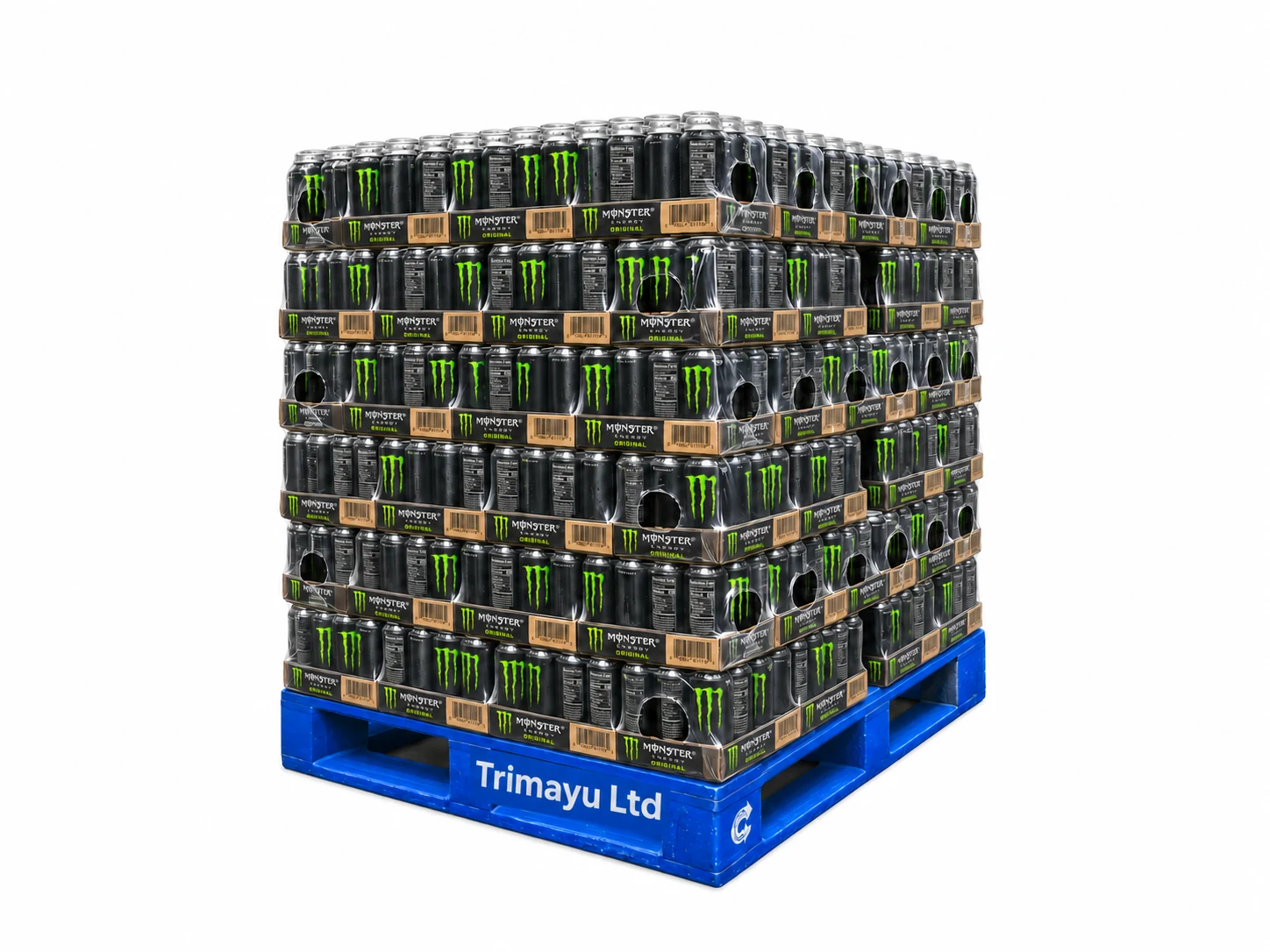
For TRIMAYU’s current listed UK reference formats, Red Bull Original, Sugarfree and Zero in 24 × 250ml cases are shown at 144 cases per full pallet, or 3,456 cans. The listed full-pallet reference for Monster 12 × 500ml is 176 cases, or 2,112 cans. Red Bull also has a UK half-pallet reference of 72 cases / 1,728 cans for the specified 24-can format; half-pallet pricing and delivery are quoted separately. These are single-format planning references rather than promises that any chosen mix can be loaded to the same count. You can check them on the TRIMAYU pallet-order planner.
Now imagine the shop sells just 12 cans of one chosen SKU a day, every day of the week. A full 3,456-can Red Bull pallet would represent 288 days—about 41 weeks of that product’s sales. The specified half-pallet would represent 144 days—about 21 weeks. At the same sales rate, a 2,112-can Monster full pallet would represent 176 days—about 25 weeks. These are simple turnover illustrations, not purchase recommendations. They show why “good price per case” and “sensible order for my shop” can be two very different things.
If an offered batch doesn’t have enough remaining selling time, or your cash and storage are limited, buying that much of a single flavour may not be appropriate. You may need a different quantity, more frequent replenishment through a supplier with suitable terms, or an agreed assortment with better sell-through across several SKUs. TRIMAYU accepts mixed-flavour and mixed-brand enquiries for review, but the requested case split, pallet count and packing compatibility must be confirmed in the quotation; the reference figures above don’t automatically apply to a mixed physical pallet.

A simple weekly stock sheet is enough to start
You don’t need sophisticated inventory software to make progress. A spreadsheet or even a well-kept notebook is enough if the numbers are accurate and someone updates them regularly. The table below shows the minimum record worth keeping for four example lines. The sales rates and counts are illustrative; they are not data from TRIMAYU or any particular convenience shop. All four use a five-day lead time and three days of safety cover solely to make the calculations easy to compare.
| Example SKU | Sales/day | Stock position | Reorder point | Next step |
|---|---|---|---|---|
| Red Bull Original 250ml | 12 | 84 | 96 | Review reorder |
| Red Bull Sugarfree 250ml | 4 | 24 | 32 | Review reorder |
| Monster Original Green 500ml | 8 | 96 | 64 | Monitor |
| Monster Ultra White 500ml | 6 | 48 | 48 | Review reorder |
The last column is a trigger to check the next order, not an instruction to buy an entire pallet for each line. Review the sheet weekly and after promotions. Adjust for delivery reliability and unusually busy weeks, and don’t hide damaged or out-of-date cans in the count of saleable stock. If you want to measure profitability as well as availability, our wholesale drinks margin guide shows how freight and the actual unit cost affect the return on an order.
Best-before dates decide whether a bulk order is really affordable
Drinks can often have a longer dated shelf life than fresh food, but the correct date is the one on the specific batch offered, not the date you expect from a brand or a product photograph. The UK government’s food and drink waste guidance distinguishes best-before dates, which concern quality, from use-by dates, which concern safety. Even where a product remains legally saleable beyond a best-before date if fit for consumption, retailers should plan to sell within the supplier-confirmed window rather than rely on that possibility.
When considering a large order, estimate cases ordered ÷ cases sold per week for each SKU and leave a buffer for transport, display and slower weeks. Keep earlier-dated stock in front, record batches and check packaging when the shipment arrives. For a more detailed explanation, see TRIMAYU’s guide to energy drink best-before dates. A full-pallet saving is not much of a saving if you need to discount or dispose of a sizeable part of the order.
Turn your stock plan into a quotation that makes sense
Before asking for a wholesale drinks price, prepare a short list with the exact brands and flavours, can or bottle sizes, cases required, minimum remaining shelf life, postcode and unloading arrangements. For UK orders TRIMAYU currently lists Red Bull from half a pallet and other featured energy-drink brands from one full pallet, with UK delivery included from one full pallet under the published terms. Red Bull half-pallet delivery and any specific handling arrangements are quoted separately; final availability and delivery arrangements depend on the actual order. If your calculated requirement is smaller than those minimums, say so clearly so you can evaluate whether the offered options really suit your shop.
A good stock plan leaves you with fewer surprises: core drinks available when customers want them, less money trapped in weak sellers and an order quantity you can explain. Once you’ve worked out your weekly sales and reasonable stock cover, send TRIMAYU an itemised wholesale enquiry. Ask for the actual cases, batch dates, total units and full delivered terms before deciding. The goal isn’t to buy the largest pallet. It’s to buy stock your customers will genuinely take off the shelf.